![special-case-sl-logo.png]](https://help.seedlegals.com/hs-fs/hubfs/special-case-sl-logo.png?width=165&height=18&name=special-case-sl-logo.png)
What do we mean by “simultaneous” conversion?
A “simultaneous” conversion means multiple SeedFASTs converting into shares in the same conversion event, using the same conversion mechanics and fully diluted base.
SeedFASTs convert into shares when a pre-determined trigger event occurs (eg. a new funding round, exit or at the longstop date). Groups of SeedFASTs that share the same commercial terms are supposed to convert at the same time, in one go.
But where the SeedFASTs have different Longstop Dates, it’s common for them to convert one after the other, or perhaps some converting at the Longstop Date and some converting on another trigger like a funding round. That can result in different economic outcomes for each investor, which may not have been the intention!
So how do you ensure all SeedFASTs convert simultaneously? Simple, you can either:
- Align the Longstop Dates of all SeedFASTs to be the same day; or
- select all the relevant SeedFASTs you want to convert (e.g. at a Longstop Date / via Instant Conversion, or within a Funding Round) and convert them within one conversion event.
Why do we recommend converting SeedFASTs simultaneously?
SeedFASTs are designed to act as bridge financing between priced rounds, not as rolling funding. Best practice is therefore to treat all SeedFASTs raised between rounds as part of a single, coordinated “mini-round” and convert them at the same time. Converting them at the same time keeps your investors on consistent terms, eliminates unnecessary admin for you and protects your investors’ S/EIS relief.
1) It keeps all SeedFAST investors on consistent terms and avoids waterfalling of conversion prices
Even with the same valuation, converting SeedFASTs at different times can sometimes lead to minor mathematical discrepancies in how the "fully diluted" share capital is calculated on conversion.
At a SeedFAST’s Longstop Date, typically the investment will convert into shares based on a previously determined “longstop valuation”. To get the conversion price, that valuation is divided by the company’s fully diluted equity (being the total shares in issue and option pool).
The issue is, when each SeedFAST converts, that fully diluted equity figure increases for the next SeedFAST when it comes to convert. This can cause a “waterfalling effect” where each later SeedFAST converts at a lower price per share than the previous one, meaning later investors get more favourable economics for no commercial reason. The investors who invested only weeks apart, on the same SeedFAST terms, can end up converting at very different prices per share.
For example:
Imagine Anthony and John both invest on the same SeedFAST terms, only a few weeks apart.
- Anthony’s SeedFAST hits its longstop first and converts at £1.00 per share.
- This conversion increases the company’s total share capital.
- When John’s SeedFAST converts a few weeks later, the price-per-share calculation now includes Anthony’s new shares. This results in a lower price, say £0.98 per share.
Despite investing on the same terms, John receives more shares than Anthony purely because of the timing. This tends to be unintentional and can snowball where there are multiple SeedFASTs in play.
2) Different triggers
It’s also possible for SeedFASTs to convert under different triggers if they don’t have aligned longstop dates. For example, one SeedFAST might reach its longstop date and convert at the fixed longstop valuation, while a SeedFAST with a later longstop date might convert at a funding round (e.g. with a discount or cap).
Imagine Sarah and Toby both invest on the same SeedFAST terms, with longstop dates that are set as 6 months from the date they invest:
- Sarah invests £50,000 in January
- Toby invests £50,000 in March
Both SeedFASTs have the same commercial terms, but Sarah’s SeedFAST reaches its longstop date first and converts at the longstop valuation of £8m (set at the valuation of the previous priced round), giving her a conversion price of £1.00 per share.
Two months later, a new funding round closes at a £15m valuation, and Toby’s SeedFAST converts as part of that round with a 15% discount, giving him a conversion price of £1.275 per share.
Even though both investors invested on the same terms only 2 months apart, Toby ends up receiving fewer shares purely because of the different conversion trigger.
Although it may not have been the intention to treat investors differently, and while the underlying mechanics look the same at first glance, timing and sequencing have an important effect on outcomes.
So investors converting at different trigger events may end up with more or less favourable economics purely because longstop dates weren’t aligned. Converting simultaneously keeps everyone on the same basis and avoids this kind of mismatch. Aligning longstop dates ensures this.
3) It reduces admin and avoids repeated steps
Sequential conversions mean repeating the same operational steps multiple times. You’ll have to manage multiple:
- Cap table updates and calculations
- Board minutes and shareholder resolutions
- Share certificate issuances
- SH01 filings with Companies House
- Investor communications
Consolidating this into one workflow is faster, cheaper and significantly less error-prone.
4) Compliance with HMRC (S/EIS Rules)
Simultaneous conversion is also very useful for S/EIS compliance.
Best practice is for SeedFASTs to convert into shares within 6 months of the investment date in order to ensure compliance with HMRC rules. If you convert sequentially, you create a complex rolling schedule of deadlines that is easy to mess up. By converting everyone at once (aiming for the deadline of your earliest investor), you simplify the process and ensure no one accidentally times out and loses their tax relief. This batch approach also keeps your HMRC paperwork clean, as every investor shares the same single date of allotment.
When might you convert sequentially instead?
Only when there’s a clear reason, e.g. a specific SeedFAST has meaningfully different terms/valuation and you intentionally want to treat it differently, but you’ll want to double-check the valuation interaction and be careful with your calculations.
How to convert all your SeedFASTs simultaneously on SeedLegals?
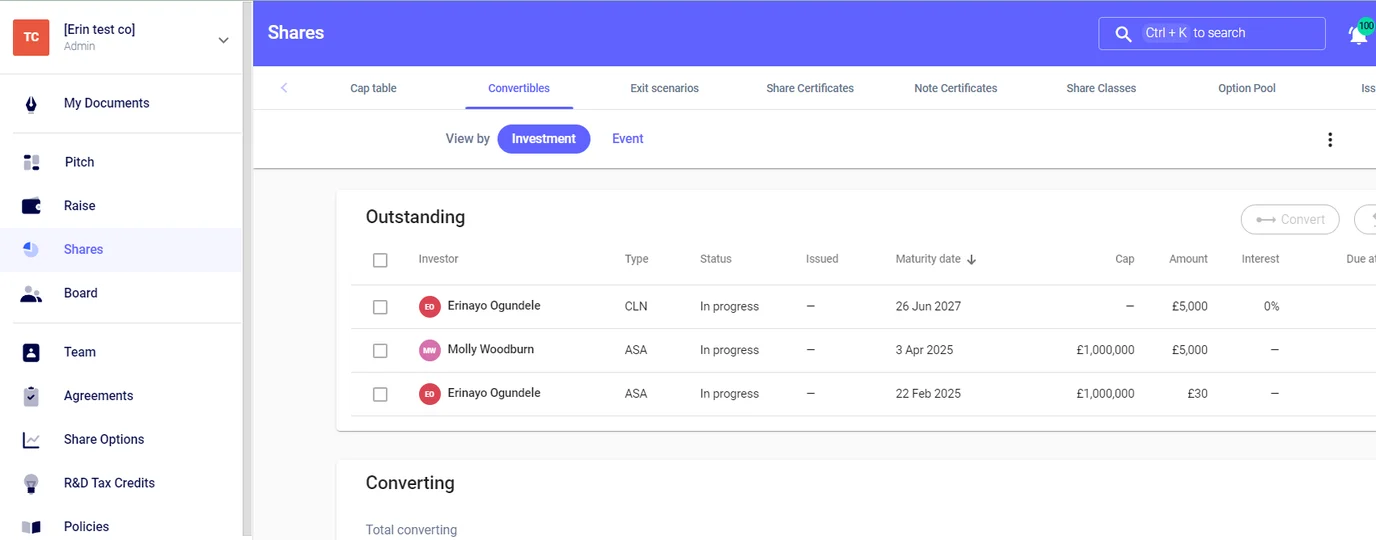
When you’d like to convert multiple SeedFASTs at the same time, select the SeedFASTs you want to convert from the Convertibles Table: